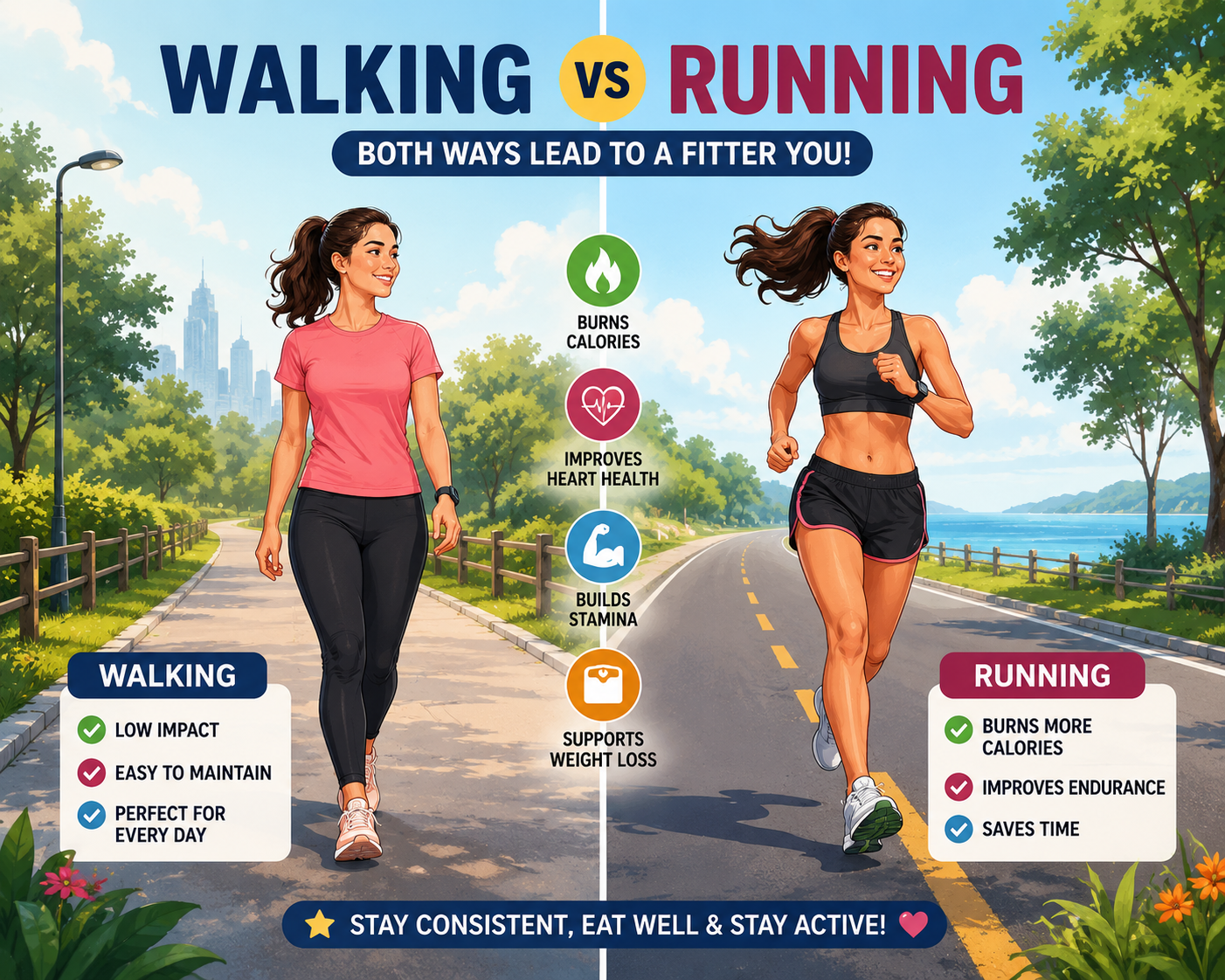
Walking and running both support healthy fat loss when paired with a balanced diet and consistent exercise. Choose the activity that matches your fitness level and lifestyle to achieve lasting results.
Walking and running are two of the most popular forms of cardiovascular exercise for people looking to lose weight and improve their overall health. Both activities help burn calories, strengthen the heart, improve endurance, and support fat loss. But many people wonder which one is actually more effective for shedding body fat — and whether one is “wasting their time” by choosing the wrong option.
The answer isn’t as simple as picking one over the other. The best exercise is the one you can perform consistently and safely. While running burns more calories in less time, walking is easier on the joints, beginner-friendly, and sustainable for the long haul.
In this guide, we’ll compare walking and running across several factors — calorie burn, joint impact, fitness gains, and long-term sustainability — to help you decide what fits your goals, body, and lifestyle best.
How Does Fat Loss Actually Work?
Before comparing the two, it helps to understand the mechanism behind fat loss.
Your body loses fat when you consistently burn more calories than you consume — a state known as a calorie deficit. Both walking and running increase your daily calorie burn, making that deficit easier to achieve.
Neither exercise can specifically burn fat from one body part (sorry, spot-reduction isn’t real). Instead, both help reduce overall body fat when paired with a balanced diet and regular strength training. Where fat comes off first is largely determined by genetics, not by which cardio you choose.
Walking for Fat Loss
Walking is one of the safest and most sustainable forms of exercise. It requires no special equipment beyond a comfortable pair of shoes and can be done almost anywhere — a park, your neighborhood, a treadmill, even the mall on a rainy day.
It’s particularly beneficial for beginners, older adults, people carrying extra weight, or anyone returning to exercise after a long break.
Benefits of walking:
- – Low impact and gentle on the joints
- – Suitable for all fitness levels
- – Easy to perform every day
- – Reduces stress and anxiety
- – Improves heart health
- – Supports healthy, sustainable weight loss
- – Lowers blood pressure
- – Improves blood sugar control
- – Easy to recover from
- – Can be maintained for longer durations without burnout
Walking also encourages consistency simply because it’s less physically demanding — you’re far less likely to skip tomorrow’s walk because today’s left you sore.
Running for Fat Loss
Running is a higher-intensity cardiovascular exercise that burns more calories in less time. Because of that intensity, it raises your heart rate significantly and can improve cardiovascular fitness faster than walking.
The tradeoff is impact: running places considerably more stress on the knees, ankles, hips, and lower back, especially if your form, footwear, or running surface isn’t ideal.
Benefits of running:
- – Burns more calories per minute
- – Improves cardiovascular fitness quickly
- – Increases endurance
- – Strengthens bones through impact loading
- – Improves athletic performance
- – Saves time compared to walking
- – Releases endorphins that boost mood (“runner’s high”)
Running is an excellent choice for people who already have a solid fitness base and no major joint issues.
Walking vs Running: Calorie Burn Comparison
Calories burned depend on your body weight, pace, age, terrain, and fitness level. For an average person weighing around 70 kg:
| Activity | Duration | Calories Burned (Approx.) |
|---|---|---|
| Walking (5 km/h) | 30 minutes | 120–150 kcal |
| Brisk Walking (6.5 km/h) | 30 minutes | 170–220 kcal |
| Running (8 km/h) | 30 minutes | 280–350 kcal |
| Running (10 km/h) | 30 minutes | 350–450 kcal |
Running burns more calories per minute, but walking can produce a similar weekly calorie expenditure if performed for longer or more frequent sessions. A one-hour walk and a 35-minute run can end up burning roughly the same number of calories — walking just asks for more of your time in exchange for less strain on your body.
A note on heavier body weight: the more you weigh, the more calories you burn per minute of either activity, since your body works harder to move more mass. This is one reason walking can be a surprisingly effective calorie-burner for beginners.
Which Burns More Belly Fat?
A common myth is that running specifically targets belly fat faster than walking. In reality, neither exercise targets belly fat specifically.
Both walking and running reduce overall body fat — including around the midsection — when combined with:
- – A calorie deficit
- – Strength training
- – Adequate protein intake
- – Good sleep
- – Stress management
Stay consistent with either activity, and your waistline will gradually shrink as your overall body fat percentage drops.
Which Is Better for Beginners?
Walking is generally the better starting point.
Reasons include:
- – Lower injury risk
- – Easier recovery
- – Less muscle soreness
- – More sustainable day to day
- – Builds cardiovascular fitness gradually, without overwhelming a body that isn’t used to exercise
Once your fitness base improves — usually after a few weeks to a couple of months of consistent walking — you can slowly introduce jogging intervals or short running sessions.
Which Is Better for Joint Health?
Walking places significantly less stress on your knees, ankles, and hips. Running increases joint loading, especially on hard surfaces like concrete or with worn-out footwear.
If you have any of the following, walking is usually the safer choice:
- Knee pain
- Arthritis
- A higher body weight
- Previous lower-body injuries
If you do want to run despite joint concerns, cushioned running shoes, softer surfaces (trail or track over concrete), and a very gradual mileage increase can help reduce risk.
Which Builds More Fitness Faster?
Running improves cardiovascular fitness more quickly because it challenges your heart and lungs at a higher intensity. However, brisk walking still delivers excellent health benefits when done consistently — research links regular walking to a reduced risk of heart disease, stroke, and type 2 diabetes, even without ever picking up the pace to a run.
Walking vs Running for Long-Term Weight Loss
If your goal is lasting weight loss, consistency beats intensity.
Walking often wins here simply because most people can comfortably do it every single day without exhaustion. Running may burn more calories in a single session, but if it leads to injury, joint pain, or burnout, it becomes hard to sustain — and an exercise you stop doing burns zero calories.
The best exercise, in the end, is the one you’ll still be doing six months from now.
Can You Combine Both?
Absolutely — and for many people, this is the ideal approach. Combining both allows you to build endurance through running while using walking days to recover and stay active without added joint stress.
Example weekly plan:
| Day | Activity |
|---|---|
| Monday | Brisk walk (45 minutes) |
| Tuesday | Run (30 minutes) |
| Wednesday | Strength training |
| Thursday | Brisk walk (45 minutes) |
| Friday | Interval run (25–30 minutes) |
| Saturday | Long walk (60 minutes) |
| Sunday | Recovery walk or rest |
This combination builds cardiovascular endurance while keeping injury risk low.
Sample Beginner Walking Plan (If You’re Starting From Zero)
If you haven’t exercised in a while, ease in rather than jumping straight to daily 45-minute walks:
- – Week 1–2: 15–20 minute walks, 4–5 days a week, at a comfortable pace
- – Week 3–4: 25–30 minute walks, 5 days a week, slightly brisker pace
- – Week 5–6: 30–40 minute walks, 5–6 days a week; add a few short bursts of faster walking
- – Week 7+: Introduce 1–2 light jogging intervals per week if you want to progress toward running
Tips to Maximize Fat Loss
- – Maintain a moderate calorie deficit — extreme restriction backfires long-term
- – Eat enough protein every day to preserve muscle while losing fat
- – Include strength training 3–4 times each week
- – Drink plenty of water
- – Sleep 7–9 hours per night
- – Stay active throughout the day, not just during workouts
- – Track weekly progress instead of obsessing over daily weight fluctuations
- – Focus on consistency rather than perfection
Common Mistakes to Avoid
- – Doing cardio without any strength training
- – “Eating back” all the calories burned during exercise
- – Ignoring recovery days
- – Wearing improper or worn-out footwear
- – Increasing running distance too quickly
- – Skipping warm-ups and cool-downs
- – Comparing your progress to someone else’s routine
Frequently Asked Questions
Can walking alone help me lose significant weight?
Yes. Walking consistently, especially at a brisk pace and combined with a reasonable calorie deficit, can produce meaningful weight loss over time. It won’t happen as fast as with higher-intensity exercise, but it’s often more sustainable, which matters more in the long run.
Do I need to run to “get fit”?
No. Cardiovascular fitness improves with any consistent aerobic activity. Brisk walking, cycling, swimming, or running can all build fitness — running is simply a faster route for people whose joints and schedule can handle it.
Should I walk or run on an empty stomach?
Either can work; this comes down to personal preference and tolerance. Some people feel more energized with a small snack beforehand, while others prefer fasted morning walks or runs. Neither approach has a meaningful advantage for fat loss specifically.
How soon will I see results?
Most people notice improved energy and mood within a couple of weeks, and visible changes in body composition typically take 6–8 weeks of consistent activity combined with proper nutrition.
Which One Should You Choose?
Choose walking if you:
- – Are new to exercise
- – Have joint pain
- – Want a sustainable daily routine
- – Prefer low-impact workouts
- – Need easier recovery between sessions
Choose running if you:
- – Already have a good fitness base
- – Want to burn more calories in less time
- – Enjoy higher-intensity workouts
- – Have healthy, pain-free joints
- – Want to improve athletic performance
For many people, combining both provides the best long-term results — walking for sustainability and recovery, running for a fitness and calorie-burn boost.
Final Thoughts
Walking and running are both effective tools for fat loss, and neither is universally “better.” Running burns more calories in less time, while walking is easier to sustain and carries a lower risk of injury. The most important factor isn’t finding the “perfect” exercise — it’s finding one that fits your lifestyle and doing it consistently.
Pair your cardio routine with a balanced diet, regular strength training, proper hydration, quality sleep, and stress management to maximize fat loss and improve your overall health.
Every step counts. Whether you walk, run, or combine both, staying active consistently is the real key to reaching — and keeping — your fitness goals.
About the Author