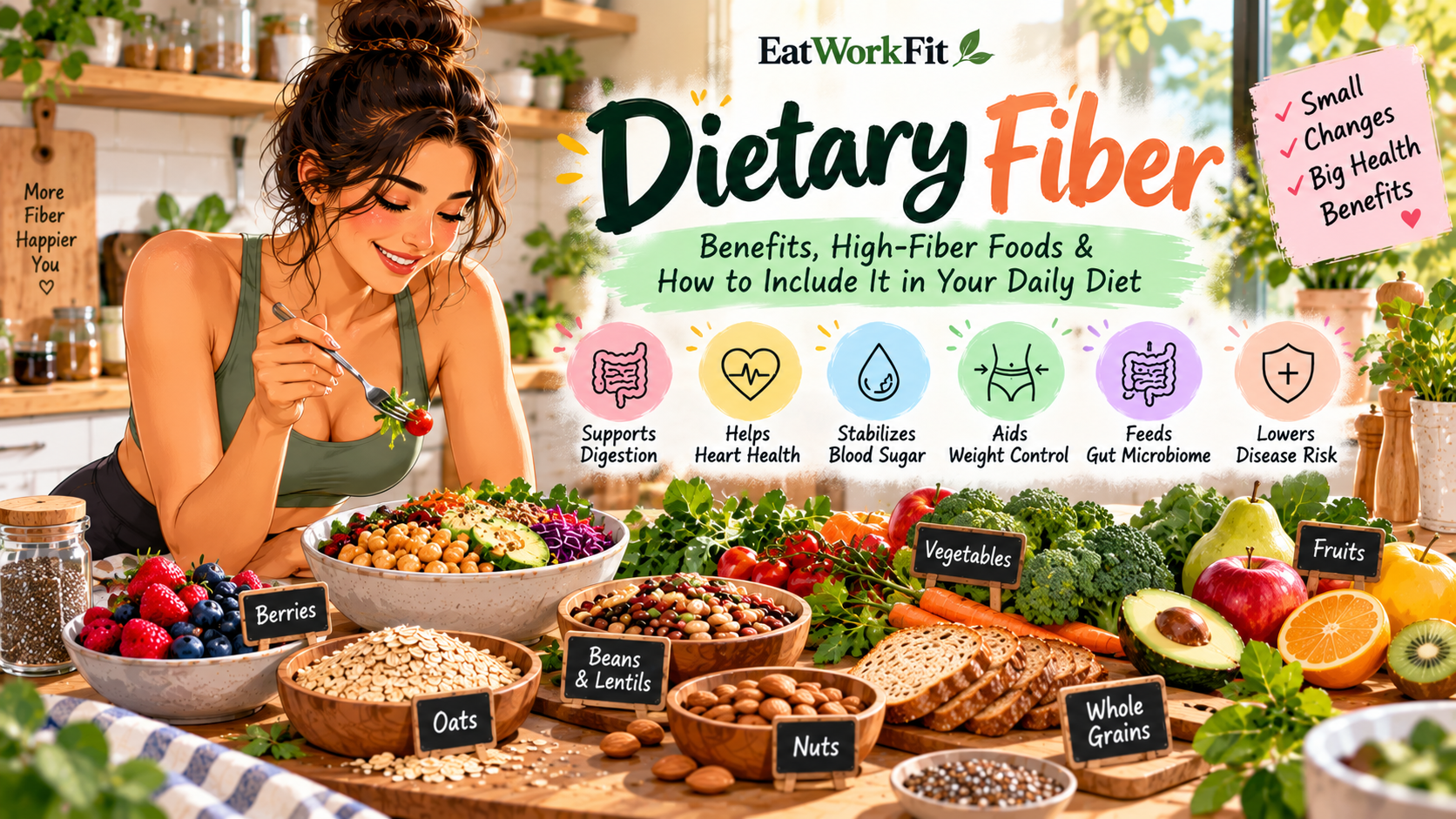
Discover the benefits of dietary fiber, the best fiber-rich foods, and practical ways to increase daily fiber intake for better digestion, gut health, cholesterol management, and weight control.
Protein gets the gym crowd’s attention, and carbs and fats get most of the diet debates. Fiber, meanwhile, sits quietly in the background, even though it may be the nutrient most strongly tied to long-term health. Higher fiber intake is consistently associated with lower risk of heart disease, type 2 diabetes, and colorectal cancer, along with better weight control and digestion. Yet most adults eat only about half the amount recommended.
What Is Fiber?
Fiber is the part of plant foods your body can’t fully digest. Instead of being broken down and absorbed like other carbohydrates, it passes through your digestive system largely intact, doing useful work along the way. There are two main types, and most plant foods contain a mix of both.
Soluble fiber dissolves in water to form a gel-like substance. It slows digestion, helps lower blood cholesterol, and smooths out blood sugar spikes. Good sources include oats, beans, lentils, apples, citrus fruits, and chia seeds.
Insoluble fiber doesn’t dissolve. It adds bulk to stool and helps food move through the gut, which supports regularity. Good sources include whole grains, wheat bran, nuts, and the skins of many fruits and vegetables.
A third category, fermentable fiber, overlaps with both types. It feeds the bacteria in your large intestine, which produce short-chain fatty acids like butyrate that nourish the cells lining your colon and help regulate inflammation.
What Fiber Does for Your Health
1. Supports digestion and regularity. Fiber adds bulk and softens stool, helping prevent constipation and straining. It’s also linked to a lower risk of diverticular disease and hemorrhoids.
2. Helps manage cholesterol. Soluble fiber binds to bile acids in the gut, which prompts the liver to pull cholesterol from the blood to make more. Oats and barley contain a soluble fiber called beta-glucan that has particularly strong evidence for lowering LDL (“bad”) cholesterol.
3. Stabilizes blood sugar. By slowing the absorption of sugars, fiber blunts the sharp rises in blood glucose that follow meals. This is especially valuable for people with insulin resistance or type 2 diabetes, and it helps steady energy levels for everyone else.
4. Aids weight management. High-fiber foods are filling and generally lower in calorie density, so you feel satisfied on fewer calories. They also take longer to chew and digest, which slows eating and extends fullness.
5. Feeds your gut microbiome. A diverse, fiber-rich diet supports a diverse community of gut bacteria, which is associated with better immune function and lower inflammation.
6. Lowers disease risk. Large population studies link higher fiber intake with reduced risk of heart disease, stroke, type 2 diabetes, and colorectal cancer, along with lower overall mortality. These are associations rather than proof of cause, but the pattern is consistent across many studies.
How Much Fiber Do You Need?
A common guideline is 25 grams per day for women and 38 grams per day for men, or about 14 grams per 1,000 calories eaten. Most adults get only around 15 grams. Needs differ slightly by age and by country, so treat these as targets rather than strict limits.
Signs You May Not Be Getting Enough
- Constipation or infrequent bowel movements
- Feeling hungry soon after meals
- Blood sugar swings and energy crashes
- Rising cholesterol levels
- Difficulty managing weight
These signs have many possible causes, so they’re prompts to review your diet, not a diagnosis.
Best Food Sources of Fiber
| Food | Approx. Fiber |
|---|---|
| Lentils, cooked (1 cup) | 15g |
| Black beans, cooked (1 cup) | 15g |
| Chickpeas, cooked (1 cup) | 12g |
| Chia seeds (1 oz) | 10g |
| Raspberries (1 cup) | 8g |
| Avocado (1 medium) | 10g |
| Pear, with skin (1 medium) | 5-6g |
| Broccoli, cooked (1 cup) | 5g |
| Oats, dry (1/2 cup) | 4g |
| Apple, with skin (1 medium) | 4-5g |
| Almonds (1 oz) | 3.5g |
| Brown rice, cooked (1 cup) | 3.5g |
| Whole wheat bread (1 slice) | 2-3g |
Exact amounts vary by variety and preparation.
How to Add More Fiber Without Discomfort
Jumping from 15 grams to 35 grams overnight is a recipe for bloating, gas, and cramping. Your gut bacteria need time to adjust.
1. Increase gradually. Add about 3-5 grams per day each week until you reach your target.
2. Drink more water. Fiber absorbs water, so without enough fluid it can make constipation worse. Keep your hydration up as your intake rises.
3. Start with easy swaps. Choose whole grain bread over white, brown rice over white rice, and whole fruit over juice.
4. Add legumes a few times a week. Stir lentils into soups, add chickpeas to salads, or make bean-based curries and stews.
5. Eat the skins. Where it’s safe and palatable, leave the skin on apples, pears, potatoes, and cucumbers.
6. Boost breakfast. Oatmeal topped with berries and a spoonful of chia or ground flaxseed can supply 10 grams or more before you’ve left the house.
7. Snack smarter. Fruit with nuts, vegetables with hummus, or air-popped popcorn all add fiber compared with refined snack foods.
8. Spread it across the day. Aim for fiber at every meal rather than loading it into one.
A Sample High-Fiber Day
| Meal | Example | Approx. Fiber |
|---|---|---|
| Breakfast | Oats with berries and chia seeds | 12g |
| Lunch | Lentil and vegetable soup with whole grain bread | 14g |
| Snack | Apple with almond butter | 6g |
| Dinner | Chicken or tofu stir-fry with broccoli and brown rice | 9g |
| Total | ~41g |
Most people don’t need to reach this level, but it shows how achievable the target is with ordinary foods.
Common Fiber Myths
“Fiber supplements are just as good as food.” Supplements like psyllium can help with specific issues such as constipation or cholesterol, but whole foods bring vitamins, minerals, antioxidants, and a wider mix of fiber types. Food should come first.
“More fiber is always better.” Very high intakes, especially if increased suddenly, can cause gas, bloating, and discomfort. Extremely high amounts can also interfere with absorption of some minerals, though this is rarely a problem on a balanced diet.
“Fiber is only about constipation.” Regularity is just one benefit. The effects on cholesterol, blood sugar, appetite, and gut bacteria are at least as important.
“Low-carb means low fiber.” Not necessarily. Vegetables, seeds, nuts, and berries are low in digestible carbs but rich in fiber, so a lower-carb diet can still hit fiber targets with some planning.
Who Should Be Careful
Some people need individual guidance rather than a blanket “eat more fiber” approach. If you have irritable bowel syndrome, inflammatory bowel disease, a recent bowel surgery, a bowel narrowing, or other digestive conditions, certain types of fiber or high amounts may worsen symptoms. Work with a doctor or registered dietitian in these cases.
The Bottom Line
Fiber is unglamorous, but it influences digestion, cholesterol, blood sugar, appetite, and your gut microbiome all at once. Most people fall well short of the roughly 25-38 grams a day recommended. The fix doesn’t require special products: build meals around beans, lentils, whole grains, fruits, vegetables, nuts, and seeds, increase intake gradually, and drink enough water. It’s one of the most reliable daily habits for improving your health over the long run.
About the Author