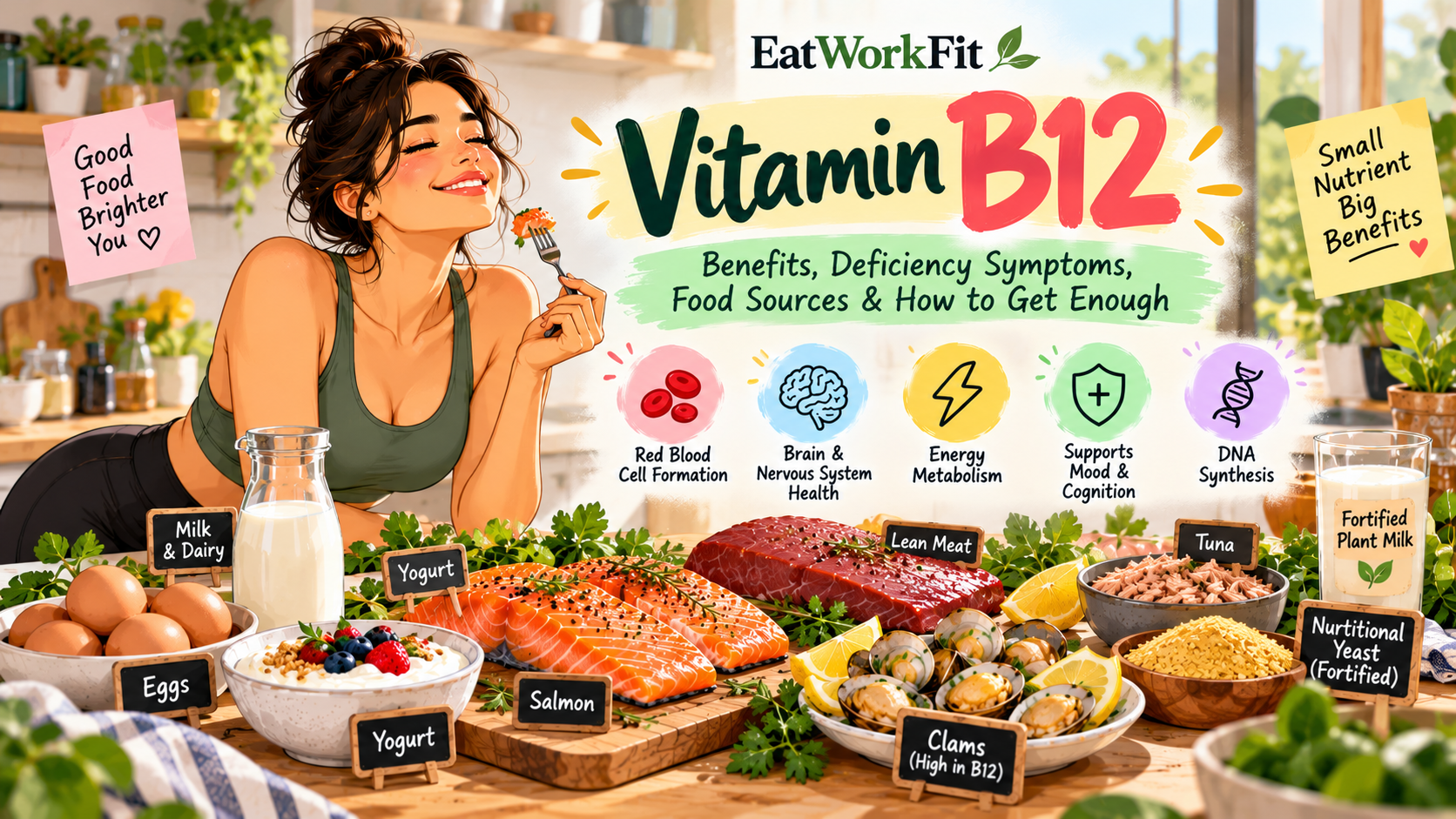
Discover the benefits of vitamin B12, common deficiency symptoms, foods rich in B12, and how to maintain healthy levels through diet, fortified foods, and supplements.
Vitamin B12 is one of the few nutrients you can’t reliably get from plants, and one of the easiest to overlook until symptoms show up. Deficiency develops slowly, often over years, and its early signs are easy to blame on stress or a busy life. Left unaddressed, it can lead to anemia and nerve damage that isn’t always reversible. Many people assume it’s only a concern for vegans, but several other groups are at risk too.
What B12 Does in Your Body
Vitamin B12 (cobalamin) is involved in several essential processes:
- Red blood cell formation. Without enough B12, the body produces large, immature red blood cells that don’t carry oxygen well, a condition called megaloblastic anemia.
- Nervous system function. B12 helps maintain myelin, the protective coating around nerves.
- DNA synthesis. Every cell that divides depends on it.
- Energy metabolism. It helps your body convert food into usable energy.
- Homocysteine regulation. B12 works with folate to keep homocysteine, an amino acid linked to cardiovascular risk when elevated, in check.
- Mood and cognitive function. It supports the production of neurotransmitters involved in mood and memory.
Why B12 Is Different From Other Vitamins
It’s found naturally almost only in animal foods. B12 is made by bacteria, and it accumulates in meat, fish, eggs, and dairy. Plants don’t produce it in meaningful amounts.
Absorption is complicated. B12 in food must be released by stomach acid, then bind to a protein called intrinsic factor, which is made in the stomach, before it can be absorbed in the small intestine. A problem at any step can cause deficiency even when your diet contains plenty of B12.
The body stores it for years. The liver holds several years’ worth of B12, so deficiency can take a long time to appear and a long time to notice. By then, the shortfall may be significant.
Who Is at Risk
Vegans and many vegetarians. Without fortified foods or supplements, vegans have almost no reliable source. Vegetarians who eat limited dairy and eggs can also run low.
Older adults. Stomach acid production often declines with age, reducing the release of B12 from food. This is a major reason deficiency is common after 50.
People taking certain medications. Long-term use of metformin (commonly prescribed for type 2 diabetes) and acid-reducing drugs such as proton pump inhibitors can lower B12 absorption.
People with digestive conditions. Celiac disease, Crohn’s disease, and atrophic gastritis can all impair absorption.
People with pernicious anemia. This autoimmune condition destroys the cells that make intrinsic factor, so B12 can’t be absorbed from food at all.
Those who have had weight-loss or stomach surgery. Removing or bypassing part of the stomach or small intestine reduces absorption.
Heavy drinkers. Chronic alcohol use can damage the stomach lining and interfere with absorption.
Signs of B12 Deficiency
Symptoms vary and often build gradually:
- Persistent fatigue and weakness
- Pale or slightly yellowish skin
- Shortness of breath and dizziness
- Tingling, numbness, or “pins and needles” in the hands and feet
- Difficulty with balance or walking
- A smooth, sore, or swollen tongue
- Memory problems, brain fog, or difficulty concentrating
- Low mood, irritability, or depression
- Mouth ulcers
Why this matters: the neurological symptoms in particular can become permanent if deficiency continues for too long. Tingling or numbness is a reason to get tested promptly rather than wait.
How Much B12 Do You Need?
The recommended daily amount for most adults is 2.4 micrograms (mcg), rising to about 2.6 mcg during pregnancy and 2.8 mcg while breastfeeding. This is a small amount, but because absorption from food and supplements varies, many people with higher risk need more than the baseline figure suggests.
Best Food Sources of B12
| Food | Approx. B12 |
|---|---|
| Clams (3 oz, cooked) | 80+ mcg |
| Beef liver (3 oz, cooked) | 60-70 mcg |
| Salmon (3 oz, cooked) | 2.5-4.5 mcg |
| Tuna, canned (3 oz) | ~2.5 mcg |
| Beef (3 oz, cooked) | ~1.5-2.5 mcg |
| Greek yogurt (1 cup) | ~1.0-1.3 mcg |
| Milk (1 cup) | ~1.2 mcg |
| Egg (1 large) | ~0.5 mcg |
| Fortified nutritional yeast (1/4 cup) | Varies widely; check label |
| Fortified plant milk (1 cup) | Typically 1-3 mcg; check label |
Values vary by brand and preparation, so check labels on fortified foods.
Testing for B12 Deficiency
A standard blood test measures serum B12, but results in the “low-normal” range can still be associated with symptoms. If your result is borderline, doctors may order additional tests such as methylmalonic acid (MMA) or homocysteine, which rise when B12 function is inadequate. If you have symptoms or belong to a higher-risk group, ask your doctor about testing rather than guessing.
Supplementing Safely
Supplements and fortified foods are the main option for anyone who doesn’t eat animal products, and often for those with absorption problems.
- Cyanocobalamin is the most studied and widely used form, stable and inexpensive.
- Methylcobalamin is another common form, often marketed as more “natural,” though evidence that it works better is limited.
- Dosing varies. Common approaches include a small daily dose or a larger dose a few times per week, since only a fraction of a large dose is absorbed at once. The right amount depends on your diet, absorption, and test results, so check with a healthcare provider.
- People with confirmed deficiency or pernicious anemia may need much higher doses or injections prescribed by a doctor, because oral supplements may not be absorbed adequately.
B12 has a good safety record at typical supplement doses because excess is generally excreted in urine, but it’s still best to follow professional guidance rather than self-prescribe high doses.
Practical Tips for Getting Enough
- If you eat animal foods, include eggs, dairy, fish, or meat regularly. Variety across these sources makes a shortfall less likely.
- If you’re vegan, use a reliable supplement and/or fortified foods consistently, and get your levels checked periodically. Don’t rely on seaweed, spirulina, or fermented foods, whose B12 is often in forms the body can’t use.
- If you’re over 50, consider asking your doctor about testing, and discuss fortified foods or a supplement, since the form of B12 in supplements and fortified foods doesn’t depend on stomach acid for release.
- If you take metformin or acid-reducing medication long term, ask about periodic B12 monitoring.
- Don’t ignore tingling, numbness, or balance changes. Get checked rather than waiting for them to resolve.
The Bottom Line
B12 is a small-quantity nutrient with outsized consequences. Because the body stores it for years and symptoms creep in slowly, deficiency often goes unnoticed until it’s advanced. If you follow a plant-based diet, are over 50, take certain long-term medications, or have a digestive condition, B12 deserves a place on your radar. A simple blood test and a consistent source, whether from animal foods, fortified foods, or a supplement, can prevent problems that are far harder to reverse later.
About the Author