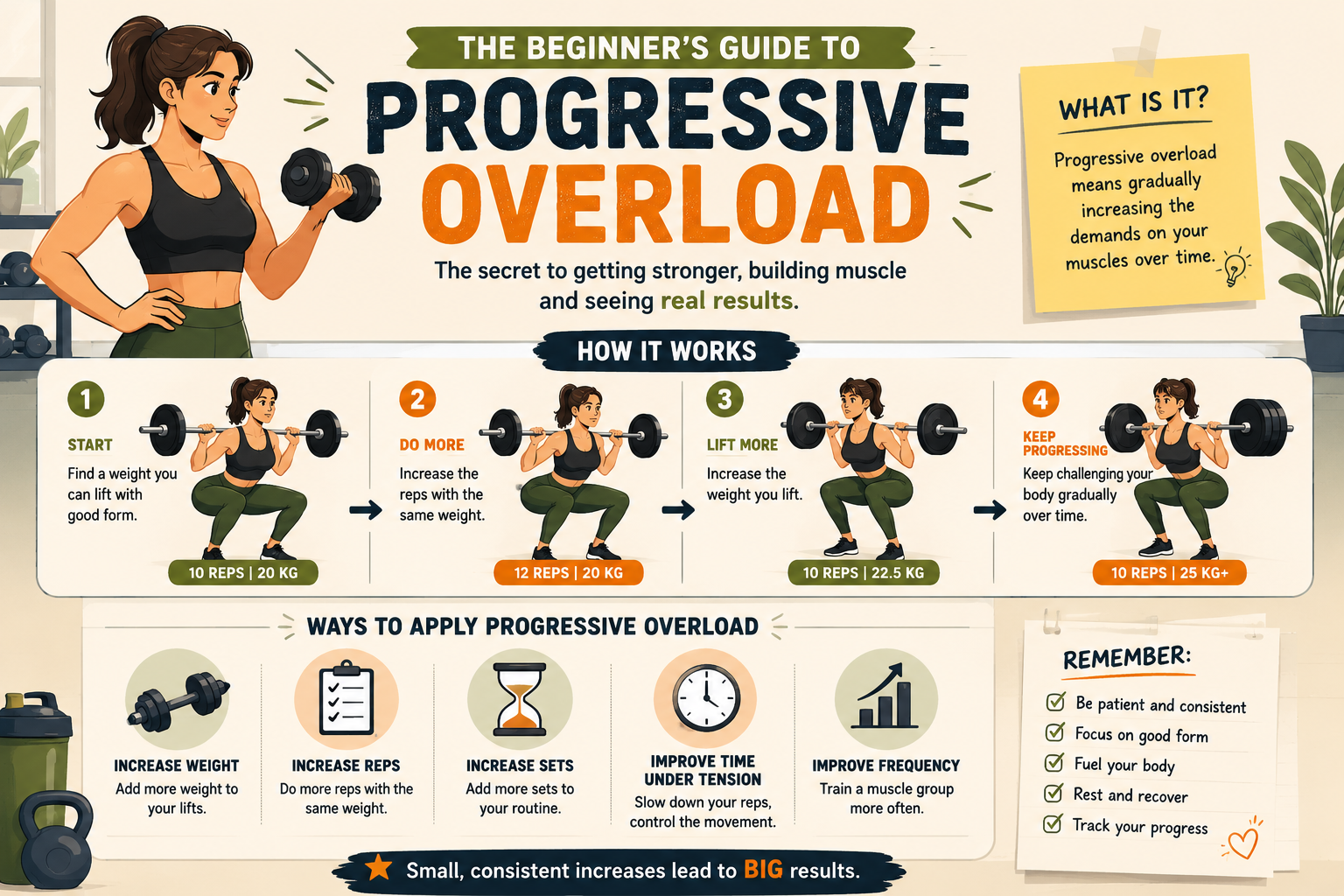
Progressive overload is the key to getting stronger and building muscle—gradually increase the challenge as your body adapts.
If you’ve been lifting the same weights for the same reps for months with nothing to show for it, you’ve likely hit a wall that has a name: lack of progressive overload. It’s the single most important principle in strength training — more important than any specific exercise, program, or supplement. Understanding it is the difference between spinning your wheels and actually building strength and muscle over time.
What Is Progressive Overload?
Progressive overload is the gradual increase of stress placed on your body during exercise. In simple terms: to keep making progress, you need to continually challenge your muscles slightly more than they’re used to. Your body adapts to the demands placed on it — if those demands never increase, neither will your strength or muscle.
This is why someone who’s been doing the exact same workout with the exact same weights for a year often looks no different than they did on day one. Their body has fully adapted to that stimulus and has no reason to change further.
Why It’s the Foundation of Real Progress
Muscles grow and strengthen in response to a process called mechanical tension — essentially, the stress placed on muscle fibers during resistance exercise. When you consistently challenge your muscles with more tension than they’re accustomed to, your body responds by adapting: building more muscle fibers, improving neural efficiency, and increasing strength capacity.
Without progressive overload, you plateau. Your body has no reason to keep adapting because the stimulus isn’t changing.
Ways to Apply Progressive Overload
Adding more weight isn’t the only way to progress — and for beginners especially, it shouldn’t be the only method relied on. Here are the main approaches:
1. Increase the Weight
The most straightforward method. Once you can comfortably complete all prescribed sets and reps with good form, add a small amount of weight (typically 2.5-5 lbs for upper body, 5-10 lbs for lower body).
2. Increase the Reps
Before adding weight, you can increase reps at the same weight. For example, going from 3 sets of 8 to 3 sets of 12 at the same load is meaningful progress.
3. Increase the Sets
Adding an additional set of an exercise increases total training volume, which is another valid form of progression, especially for beginners still building work capacity.
4. Increase Training Frequency
Training a muscle group more often per week (within reason and with adequate recovery) increases total weekly volume, which can drive additional progress.
5. Decrease Rest Time
Shortening rest periods between sets while maintaining the same weight and reps increases the overall intensity and metabolic demand of a workout.
6. Improve Range of Motion
Performing an exercise through a fuller range of motion (e.g., a deeper squat) increases the difficulty and muscle engagement even without adding weight.
7. Improve Form and Control
Slowing down the eccentric (lowering) portion of a lift or reducing momentum/swinging increases time under tension, making the same weight more challenging in a productive way.
A Simple Progressive Overload Framework for Beginners
You don’t need to increase every variable every session — that leads to burnout and injury risk. Instead, use this simple beginner progression:
- Weeks 1-2: Focus entirely on form and consistency at a manageable weight
- Weeks 3-4: Once all sets/reps feel manageable with good form, add small weight increases
- Ongoing: When you can complete all prescribed reps across all sets with good form for two consecutive sessions, increase weight slightly
Example progression on squats:
- Week 1-2: Bodyweight squats, 3×12, focus on depth and control
- Week 3-4: Goblet squats with light dumbbell, 3×10
- Week 5-6: Increase dumbbell weight once 3×10 feels manageable
- Week 7+: Continue adding small increments as strength improves
How to Track Progress Properly
Progressive overload only works if you know what you did last time. Keep a simple workout log — a notebook or phone note works fine — tracking:
- Exercise
- Weight used
- Sets and reps completed
- How the last rep of each set felt (easy, moderate, near failure)
Without tracking, it’s easy to unintentionally plateau because you have no reference point for whether you’re actually progressing.
Common Mistakes Beginners Make
- Adding weight too quickly, sacrificing form and increasing injury risk
- Only focusing on weight increases, ignoring reps, sets, and range of motion as valid progression tools
- Progressing every single session, which isn’t sustainable — plan for some sessions to simply maintain while your body adapts
- Neglecting recovery, which is when your body actually builds strength in response to training stress
- Comparing progress to others rather than tracking your own trajectory — progressive overload is individual and depends on starting point, recovery, and consistency
Signs You’re Applying Progressive Overload Correctly
- You’re able to lift slightly more weight, do slightly more reps, or complete workouts with better form over weeks and months
- You feel challenged in your working sets, typically leaving 1-3 reps “in the tank” rather than failing early or coasting easily through
- You’re recovering well between sessions — soreness is present but not debilitating
The Bottom Line
Progressive overload isn’t a complicated concept, but it’s the mechanism behind essentially all strength and muscle-building progress. Whether you add weight, reps, sets, or improve your form and range of motion, the key is ensuring your body is consistently challenged slightly more than it was before. Track your workouts, progress gradually, and prioritize recovery — and the results will follow naturally over time.
About the Author