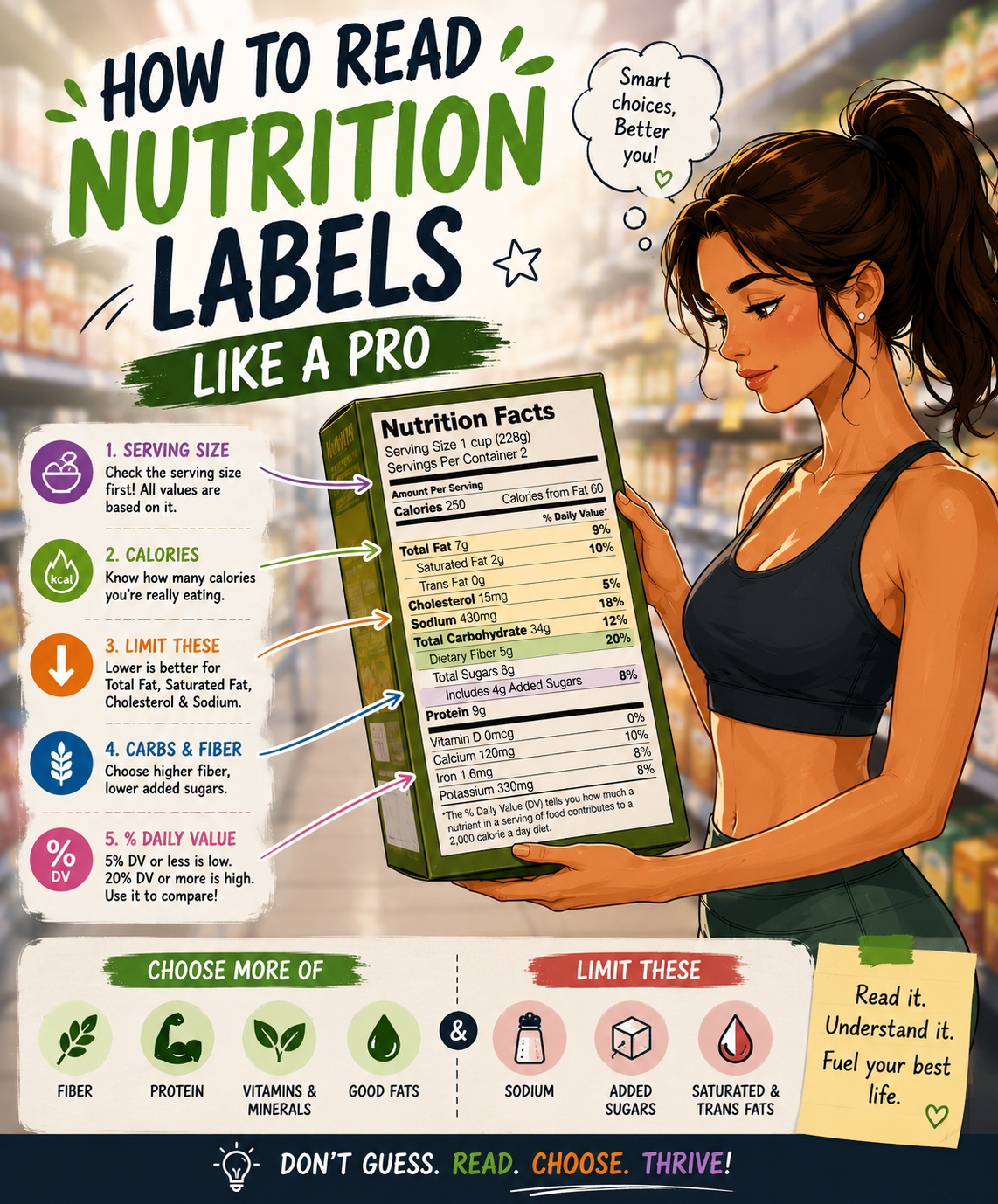
Understanding nutrition labels helps you make healthier food choices by comparing serving sizes, calories, nutrients, and ingredients before you buy.
Walk into any grocery store and you’ll see labels everywhere — “low fat,” “all natural,” “sugar free,” “high protein.” Marketing claims on the front of packaging are designed to sell, not inform. The real information you need is on the back, in the nutrition facts panel and ingredients list. Once you know how to read it properly, you can see through marketing spin and make decisions based on what’s actually in your food.
Why Nutrition Labels Matter
Front-of-package claims are largely unregulated in terms of how “healthy” something actually sounds. A cereal box can say “made with whole grains” while still being mostly sugar. A yogurt can say “low fat” while being loaded with added sugar to compensate for taste. The nutrition facts panel cuts through this — it’s standardized, factual, and required by law to reflect what’s actually in the product.
Step 1: Start With the Serving Size
This is the most commonly overlooked part of a nutrition label — and the most important. All the numbers on the label (calories, fat, sugar, etc.) are based on one serving, not the entire package.
Common trap: A bag of chips might list 150 calories per serving, but if the bag contains 3 servings and you eat the whole thing, you’ve actually consumed 450 calories. Always check the number of servings per container before assuming the listed values apply to what you’re about to eat.
Step 2: Check Total Calories
Calories tell you how much energy the food provides. This number should be evaluated in the context of your daily calorie needs and how the rest of your day looks — a 300-calorie snack means something different depending on what else you’ve eaten.
Step 3: Look at Macronutrient Breakdown
Total Fat
- – Look for the breakdown between saturated fat, trans fat, and unsaturated fat
- – Aim to keep saturated fat intake moderate and avoid trans fat entirely — it has no safe level of consumption and is linked to heart disease
- – Note: some labels list trans fat as “0g” even with small amounts present due to labeling loopholes — check the ingredients list for “partially hydrogenated oils” as a red flag
Total Carbohydrates
- – This includes fiber, sugar, and starches combined
- – Dietary fiber should be as high as possible — it supports digestion, blood sugar control, and satiety
- – Added sugars (listed separately from total sugars on most modern labels) are the number to watch closely — this reflects sugar added during processing, not naturally occurring sugar (like in fruit or plain dairy)
Protein
- – Higher protein content generally indicates a more satiating, muscle-supportive food
- – Compare protein-to-calorie ratio when choosing between similar products (e.g., Greek yogurt vs regular yogurt)
Step 4: Watch for Added Sugar Specifically
Added sugar is one of the most important numbers on the entire label, and it’s often hidden in foods that don’t taste overtly sweet — pasta sauces, salad dressings, granola bars, and bread. The general recommendation is to keep added sugar under 25g/day for women and 36g/day for men, though lower is generally better.
Sneaky sources of added sugar to watch for:
- – Flavored yogurts
- – Granola and “healthy” cereal bars
- – Pasta and marinara sauces
- – Salad dressings and marinades
- – Flavored coffee creamers
Step 5: Check Sodium Levels
High sodium intake is linked to increased blood pressure and water retention. Processed and packaged foods are often the largest source of sodium in the average diet — far more than the salt shaker at home. A general target is under 2,300mg/day, with many health guidelines suggesting closer to 1,500mg for optimal heart health.
Reference point: anything above 400mg of sodium per serving is considered high; look for options under 140mg per serving when possible for lower-sodium choices.
Step 6: Read the Ingredients List
The nutrition facts panel tells you what’s in the food quantitatively, but the ingredients list tells you what it’s actually made of — and ingredients are listed in order of quantity, meaning the first few ingredients make up the bulk of the product.
Things to watch for:
- – Long lists of unrecognizable ingredients often signal heavy processing
- – Multiple names for sugar (high fructose corn syrup, dextrose, maltose, cane juice, agave) can be split up to appear lower on the list while still contributing significant total sugar
- – Whole food first — if a product claims to be “whole grain” but grain isn’t one of the first few ingredients, it’s likely a marketing claim more than a nutritional reality
Common Front-of-Package Claims Decoded
| Claim | What It Actually Means |
|---|---|
| “Low fat” | May be high in added sugar to compensate for taste |
| “All natural” | Largely unregulated term; doesn’t guarantee minimal processing |
| “Sugar free” | May contain artificial sweeteners; check ingredients |
| “Multigrain” | Contains multiple grain types — doesn’t mean whole grain |
| “Made with real fruit” | May contain a small amount of fruit alongside significant added sugar |
| “Light” or “Lite” | Typically means reduced calories or fat vs. the original product, not necessarily “healthy” |
A Quick 4-Step Label-Reading Checklist
- – Check the serving size and how many servings are in the package
- – Scan added sugar and sodium — these are the numbers most often hidden by marketing
- – Check fiber and protein — higher is generally better for satiety and nutrition
- – Skim the ingredients list — shorter, more recognizable lists generally indicate less processing
The Bottom Line
Nutrition labels are one of the most useful tools available for making informed food choices, but only if you know where to look. Ignore the front-of-package marketing, go straight to the serving size, added sugar, sodium, and ingredients list, and you’ll have a much clearer picture of what you’re actually eating — regardless of how the packaging tries to spin it.
About the Author